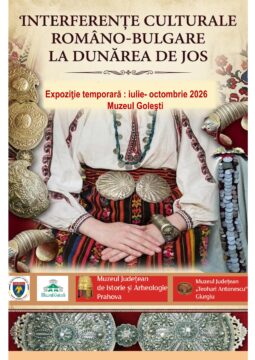
The Golești Museum of Viticulture and Fruit Growing, in partnership with the „Teohari Antonescu” Giurgiu County Museum and the Prahova County Museum of History and Archaeology, invites you to discover the exhibition Romanian–Bulgarian Cultural Connections on the Lower Danube.
The exhibition brings together an important selection of Romanian and Balkan heritage objects, illustrating cultural influences, exchanges and distinctive local traditions. Dating from the 19th and early 20th centuries, many of the exhibits belonged to Bulgarian communities that settled in the Romanian Plain around two centuries ago.
Highlights include festive women’s costumes, interior textiles and ceremonial jewellery associated with the Bulgarian community of Băleni-Sârbi, Dâmbovița County. The traditional costumes preserved by the Giurgiu Museum were collected directly from their owners during ethnographic research campaigns in 1971–1972.
Particularly striking are the elaborate ornaments once worn by Bulgarian women and girls. Jewellery marked important stages of life, served a protective and symbolic role, and often accompanied traditional dances with its distinctive sound. Coin necklaces also reflected the wearer’s social and economic status and were reserved for festive occasions.
The exhibition features impressive bridal and ceremonial accessories, including forehead ornaments (prochelnik), coin-decorated bridal crowns, necklaces (gerdan), large ornamental buckles (pafta), bracelets (grivina), coloured glass beads and rings (prâsten).
Another important element of Bulgarian traditional dress is the belt, valued for its practical, decorative and symbolic functions. Wide belts were often fastened with richly decorated pafta buckles made of silver or other metals and embellished with enamel, semi-precious stones or filigree. These remarkable objects demonstrate the exceptional craftsmanship and artistic skill of the workshops in which they were created.
Through the richness of its colours, textiles, costumes and ceremonial jewellery, the exhibition offers a vivid insight into Bulgarian traditional culture and stands as a testimony to centuries of peaceful coexistence, cultural exchange and mutual influence between Romanians and Bulgarians.
Text: Cristina Boțoghină, Head of the History and Pedagogy Department
Translate by Camelia Călin