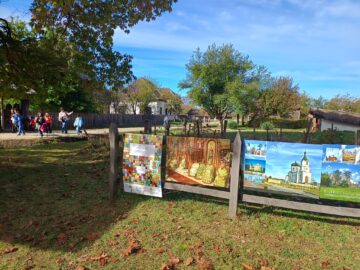
Until the end of October, Golești Museum invites visitors to discover the photographic exhibition “The Colours of Orthodoxy: Poland”, a visual exploration of Poland’s rich Eastern Christian heritage. Beyond its artistic and documentary value, the exhibition offers an opportunity to reflect on more than six centuries of Romanian–Polish cultural, religious, and intellectual connections.
Although Poland has historically been associated with Roman Catholicism, its religious landscape has long reflected a remarkable diversity of traditions. The Union of Lublin (1569), which established the Polish–Lithuanian Commonwealth, brought together Catholic, Orthodox, and other religious communities. Later, the Union of Brest (1596) led to the emergence of the Greek Catholic Church, which preserved the Byzantine liturgical tradition while entering into communion with Rome.
Within this multicultural environment, cities such as Lviv, Kyiv, and Vilnius became important centres of religious scholarship, printing, and intellectual exchange.
Moldova and Poland: Centuries of Shared History
Relations between medieval Moldova and Poland were formally strengthened in 1387, when Prince Petru I Mușat pledged allegiance to King Władysław II Jagiełło in Lviv. Over the following centuries, political alliances, trade, and cultural exchanges fostered lasting connections between the two regions.
One remarkable testimony to these ties is the Dormition Church in Lviv, historically known as the Wallachian Church. Its earlier building was erected between 1547 and 1559 with the financial support of Moldavian Prince Alexandru Lăpușneanu and his wife, Ruxandra. Rebuilt between 1591 and 1629, the church remains a symbol of Moldavian patronage and support for Orthodox communities.
Romanian Scholars and Clergymen in the Polish–Lithuanian World
Several prominent figures of Romanian cultural history were educated or pursued their activities within the historical territories of Poland and the Polish–Lithuanian Commonwealth.
Petru Movilă (Petro Mohyla, 1596–1647), a member of Moldova’s ruling family, became Metropolitan of Kyiv in 1633. A major reformer of Orthodox education, he helped establish the intellectual foundations of the Kyiv-Mohyla Academy. His close relationship with Moldavian Prince Vasile Lupu also encouraged the development of printing and religious scholarship in Iași.
Dosoftei (1624–1693), educated in Lviv, was a pioneer of Romanian religious literature. His celebrated Psalter in Verse, printed in 1673 at Univ Monastery, was influenced by the Polish poet Jan Kochanowski. Following the military campaign of King John III Sobieski in 1686, Dosoftei spent his final years in Poland, where he died in exile.
The chroniclers Grigore Ureche (c. 1590–1647) and Miron Costin (1633–1691) also received their education in Polish Jesuit colleges. Their exposure to Renaissance humanism and Polish historiography profoundly influenced the development of Romanian historical writing and the understanding of the Romanians’ Latin origins.
These personalities illustrate the essential role of Romanian–Polish cultural exchanges in shaping early Romanian intellectual and literary traditions.
A Living Heritage
Despite the profound transformations of the twentieth century, including border changes, war, and forced population transfers, Poland’s Orthodox and Greek Catholic communities have preserved an extraordinary spiritual and architectural heritage.
In 2013, UNESCO recognised 16 wooden churches (tserkvas) of the Carpathian region, eight located in Poland and eight in Ukraine, as World Heritage sites. These monuments reflect a remarkable synthesis of Byzantine religious traditions and local craftsmanship.
Through “The Colours of Orthodoxy: Poland”, Golești Museum invites visitors to explore this fascinating heritage while rediscovering the historical connections that have linked Romanian and Polish culture for centuries.
The exhibition is not merely a celebration of religious art and architecture, but also an invitation to reflect on shared history, cultural dialogue, and the enduring spiritual bonds of Eastern Europe.
We look forward to welcoming you to Golești Museum until the end of October!